Wandering With Pride · Miami pilot 2026

Safety that works when nothing else does.

WanderSafeMesh is Miami's first community-owned emergency mesh: 100 solar nodes delivering safety information, emergency alerts, and crisis contacts to LGBTQ+, Deaf, disabled, undocumented, and unhoused residents when apps, cell towers, and power grids fail.

Photoreal render of a WanderSafeMesh node v1: cream IP67 enclosure with solar panel on top, color e-ink display, side mounting bracket. Open interactive 3D model →
Node v1 · 3D-printed IP67 enclosure · 5 W solar · LoRa 915 MHz · LiFePO4 battery
100 nodesMiami pilot 2026
$144 / nodeOpen-source BOM
72h offlineLiFePO4 + 5 W solar
Zero surveillanceArchitecturally enforced

The gap

Apps fail when emergencies are real.

During Hurricane Ian, Miami-Dade's cell towers overloaded in hours. During an ICE sweep, a cell-connected app is a liability. When you're Deaf, unhoused, or don't speak English, official emergency systems were never built for you.

The mesh

Offline by design. Community by architecture.

Each node runs AES-256 encrypted LoRa mesh firmware — connecting to neighbors without internet, cell service, or power. Icon-first e-ink display for Deaf users. Audio mode for blind users. Three tactile buttons. Panic button routes to community responders — never police.

  • No internet, no problem. 915 MHz LoRa radio reaches ~1.2 km in dense urban terrain. 100 nodes blanket five Miami neighborhoods.
  • No cell tower needed. Mesh self-heals around any failed node. Hurricane outages don't cripple the network.
  • No login, no account. Walk past an LFL post, read the icons, that's it.
  • No location tracking. Nodes broadcast environmental data, not visitor data.
  • Three languages on every display. English, Spanish, Haitian Creole — chosen at the city-config layer.
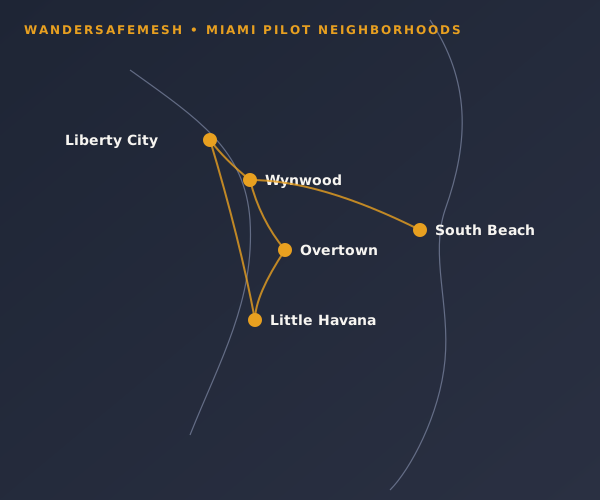
Miami neighborhood map with WanderSafeMesh nodes in Wynwood, South Beach, Overtown, Liberty City, and Little Havana, connected by mesh signal lines.
Phase 1 · 5 neighborhoods · 100 nodes · ~1.2 km LoRa range

The hardware

$144. Solar. 72 hours. Open source.

3D-printed enclosure. Heltec LoRa32 v3 (ESP32-S3 + SX1262, 915 MHz). LiFePO4 battery (3000 mAh). 5 W solar. IP65 weatherproof. Mounted at ADA height on Little Free Libraries across Wynwood, South Beach, Overtown, Liberty City, and Little Havana.

ComponentSpec
RadioLoRa 915 MHz · AES-256 mesh · ~1.2 km urban range
MCUHeltec LoRa32 v3 · ESP32-S3 · SX1262
BatteryLiFePO4 3000 mAh · 72h no-sun runtime
Solar5 W panel · 4h full-sun recharge
Display2.9″ 3-color e-ink · icon-first · 0 mW standby
Interface3 tactile buttons · audio mode · panic button
SensorsBME280 · PMS5003 · HC-SR04 · AS3935
EnclosureIP65 · 3D-printed · STL open source · ADA-height mount
Cost$144 / node · CC BY 4.0 firmware

The sensor suite

Four sensors. Each one earns its place.

Every sensor must serve a directly observable community need. Microphones, cameras, and passive Bluetooth/WiFi scanners are permanently off the component list — not as policy, as a hardware bill of materials choice.

BME280 · I²C

Heat · humidity · pressure

±0.5 °C, ±3 % RH, ±1 hPa. A pressure drop above 3 hPa in three hours triggers a storm advisory. Heat index above community threshold triggers a heat alert — the same metric NIOSH uses for outdoor worker exposure.

PMS5003 · UART

PM2.5 · PM10 air quality

Continuous PM2.5 grid in five LGBTQ+ Miami neighborhoods. EPA EJScreen calibration candidate. PM2.5 above 35 µg/m³ triggers an advisory; above 55 µg/m³ an unhealthy alert. Vented PTFE-membrane port keeps rain out, air in.

HC-SR04 · Ultrasonic

Flood · water level

Distance-to-water at 5 cm accuracy. Above 50 mm baseline triggers a flood advisory; above 200 mm triggers an evacuation alert. Privacy: only neighborhood-aggregate flood data ever leaves the city — node-level levels could reveal who's sheltering in place.

AS3935 · Franklin SPI

Lightning detection

1–40 km range, 14-step distance algorithm. Three nodes detecting the same strike + TDOA analysis = ~1–2 km strike location. The first community-owned urban lightning map. Lightning is the #1 cause of weather-related outdoor deaths in Florida — Pride, Calle Ocho, beach events sit in the bullseye.

The covenant

Zero surveillance. Architecturally enforced.

Trust isn't a policy. It's an engineering requirement. This is not a policy — it is a design constraint. A community member who walks past a node, has no phone, speaks no English, and has never heard of WanderSafe should still be able to confirm the device is not surveillance — within 30 seconds, without help from us.

  • No camera. No microphone. No Bluetooth or WiFi scanning. No GPS lookup of devices passing by.
  • AES-256 encrypted LoRa mesh — community holds the keys, not WanderSafe staff.
  • Every node broadcasts a signed null-surveillance declaration every 15 minutes, readable by any nearby device.
  • Firmware is CC BY 4.0 open source. Anyone can verify what the node does and does not do.
  • Standard 37: warrant canary built into firmware. Any compelled disclosure breaks the canary.
  • Standard 39: a community board — elected by the neighborhood, not WanderSafe — controls all researcher data access.
  • STL files are CC BY 4.0. Any makerspace can print replacement parts.
  • Government cannot subpoena data that does not exist. Architecture, not promise.

The 10-year roadmap

Miami is the proof. 100 cities is the goal.

Miami is not the destination. Miami is the proof. What's proven in Miami is a replicable, open-source, community-sovereign resilience infrastructure model that any marginalized-population organization can deploy in any city.

Phase 1 · Year 1–2

Miami

100 nodes · 5 neighborhoods · Knight Cities Challenge $200k · 15 LFL hosts · SAVE Miami partnership.

Phase 2 · Year 2–3

Knight 4-city

Detroit, Philadelphia, Long Beach, New Orleans. ~400 additional nodes. FEMA BRIC application path.

Phase 3 · Year 3–5

Metro 8

NYC, LA, Chicago, SF, Seattle, Austin, Portland, Atlanta. ~2,200 nodes. NSF CIVIC + HRSA Health Equity. First peer-reviewed paper.

Phase 4 · Year 5–7

Broaden

+16 cities. Indigenous communities, farmworker regions, public housing, reentry communities. Same architecture, city-config adapted.

Phase 5 · Year 7–10

National

100 cities · ~10,000 nodes · ~1,500 paid community ambassadors · the first community-owned national environmental safety network.

Common questions

If you're new to mesh networks.

Who does WanderSafeMesh actually serve?
The communities existing emergency infrastructure fails: undocumented immigrants, unhoused people, LGBTQ+ residents with histories of institutional harm, low-income renters in flood-prone neighborhoods, and environmental-justice communities with disproportionate air quality and climate risk. The network exists to serve them — not data brokers, not governments, not researchers.
Why not just use cell phone alerts?
Existing tools have four gaps: they require internet and smartphones; they require trust in institutions (which many communities don't have for good reason); they don't monitor hyperlocal hazards (NWS data is regional, the corner you live on is not); and they don't feed data back to the community. WanderSafeMesh closes all four. Walk past a node, see the display, that's it.
Is the data sold?
No. Aggregate environmental data is published CC BY 4.0 — anyone, including researchers, can use it. Cost-recovery revenue from research subscriptions and event APIs funds maintenance. The hard rule: revenue is cost-recovery for infrastructure, never profit extraction from the community.
What happens if WanderSafe (the org) shuts down?
Open-source firmware (CC BY 4.0) and open-source STL files mean any makerspace can keep nodes running. Each city's QR code resolves to a community-partner-hosted page (SAVE Miami in Phase 1), not WanderSafe's server. The local community board can keep operating without us.
Why Little Free Libraries?
LFL stewards are community trust anchors — already part of neighborhood fabric, maintained by volunteers who live there. LFL hosts get a physical education kit, a laminated card explaining the device, and direct contact with the community board. The node on an LFL works for everyone: no login, no phone, no English required.
How does the panic button route?
To community responders — never police. The list of responders is set per-city by the local community board (in Miami: SAVE Miami crisis line). The button is intentionally non-routable to law enforcement; that routing is enforced in firmware, not in policy.

Three doors

Pick the one that fits.

WanderSafeMesh is funded by Wandering With Pride Inc. (501(c)(3), EIN 99-3467744). Contributions to support hardware deployment are tax-deductible.

For partner organizations

Partner with us

SAVE Miami, LFL stewards, neighborhood ambassadors, city emergency management. We fund the hardware; you anchor the community trust.

Partner inquiry →
For foundations & grant officers

Fund a phase

Phase 1 ($200k) is Miami pilot. Phase 2 ($1.5M) is the four-city Knight expansion. Phase 3 has a FEMA BRIC pathway. Diligence packet on request.

Funder inquiry →
For volunteers & ambassadors

Help build it

Solder a node. Print an enclosure. Translate a display string. Steward an LFL. The hardware is open source and the work is real.

Volunteer →
Or make a tax-deductible gift →